
Work booths
The work booth has become one of the most requested products in modern offices. Activity-based working has made open-plan layouts the norm, and that creates a real problem: there’s nowhere to focus. No dedicated space for deep work, no way to step away from the noise without leaving the floor. The work booth is the practical answer.
Glimakra of Sweden makes five work booths for commercial interiors: Arrow, Limbus Original, Limbus Soft, Limbus Sub and Limbus Hexagon. All five are fabric-upholstered, sound-absorbing and modular, designed for the acoustic and aesthetic demands of activity-based offices.


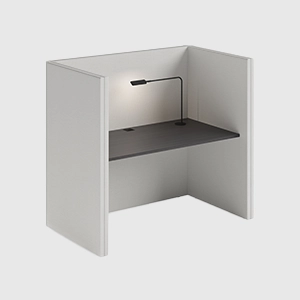
What is a work booth, and why does it work in activity-based offices?
A work booth is a freestanding, screened workstation that gives one or two people a temporary focus space directly in the open-plan office. Unlike a built-in meeting room, a booth needs no planning permission, no structural work, and can be repositioned whenever the layout changes.
In an activity-based office, employees don’t have fixed desks. That creates flexibility and collaboration, but it also creates a problem for anyone who needs to concentrate. Without a dedicated space for focused work, interruptions are constant and output suffers. A work booth addresses this by providing:
- Acoustic screening against ambient noise
- Visual privacy without isolating the user
- A proper work surface with a desk and optional power supply
- Flexibility: reconfigurable and repositionable when the office changes
Glimakra of Sweden’s work booths combine these functions with Scandinavian design and high-quality materials.
Arrow: modular work booth with wide configuration options
Arrow work booth is built for offices with high demands on both acoustics and layout flexibility. The structure is a finger-jointed timber frame with a pointed edge profile, fabric-upholstered and edged with cord. Black conical levelling feet give it a precise, geometric look that holds its own in modern, open-plan environments.
What sets Arrow apart is how far it can be configured. It’s available in C, S and H arrangements and can be combined at 90°, 180° and 360° angles, as well as in quarter-circle sections. That means Arrow can scale from a single-user focus station to a connected zone covering a whole section of the office floor. The work surface comes with a fixed top or an integrated power unit.
Arrow suits offices that:
- Need flexible layouts that can scale or be reconfigured as the team changes
- Prioritise acoustic screening across large, open areas
- Work activity-based and need clearly defined, separated focus zones
Limbus Original: work booth for the activity-based workplace
Limbus Original work booth is designed specifically for the temporary workstations that define activity-based offices. Rounded corners and a softer shape mean it sits naturally in environments where the overall look matters as much as the function. The electrically height-adjustable desk makes it comfortable for any user regardless of height, which is essential where nobody has a fixed place.
Limbus Original is available in C and H arrangements and can be configured in different sizes and materials to suit the office’s needs and interior scheme. The softer form and ergonomic flexibility make it a practical choice for organisations that take as much interest in employee wellbeing as they do in how their office works.
Limbus Original suits offices that:
- Want an attractive, softer aesthetic that doesn’t dominate the room
- Have employees of different heights and need ergonomic adjustment built in
- Are looking for a focus booth with a warm, inviting feel
More work booths in the range
Limbus Soft: when speech privacy is the priority
Limbus Soft work booth is available in C and H arrangements and is aimed at activity-based offices that need temporary workstations for individual focused work. The sound-dampening structure reduces noise propagation, and adding a work surface significantly improves absorption at low frequencies. The booth can be specified with a fixed desk top, and size and materials can be tailored to the environment.
Limbus Sub: maximum sound absorption, low weight
Limbus Sub work booth uses the most sound-absorbing screen in the range and is aimed at spaces where acoustic performance needs to be pushed as far as possible. Despite having large screen surfaces, the structure is light and easy to move. Available in C and H arrangements in both single and double configurations.
Limbus Hexagon: geometric form for clusters of focus workstations
Limbus Hexagon work booth uses a six-sided shape to create efficient focus workstations. The user is surrounded by five screens, which gives a greater sense of enclosure than a standard layout. When several hexagons are clustered together, screens are shared between workstations, bringing the cost per work point down. Work surfaces are integrated into the structure and available in several finishes; assembly uses Glimakra’s own connection system.
| Model | Structure and form | Best suited to |
|---|---|---|
|
Arrow work booth |
Finger-jointed timber frame, pointed edge profile, conical levelling feet. C, S and H arrangements, angles at 90°, 180° and 360° plus quarter-circle sections. Fixed top or integrated power unit. |
Large open-plan offices where multiple focus zones need to connect |
|
Limbus Original work booth |
Rounded corners, softer shape. C and H arrangements. Electrically height-adjustable desk. |
Activity-based offices with varied users who need ergonomic adjustment |
|
Limbus Soft work booth |
Sound-dampening structure. C and H arrangements; fixed desk top as option. Work surface improves low-frequency absorption. |
Temporary workstations where speech privacy and low-frequency sound control matter most |
|
Limbus Sub work booth |
The most sound-absorbing screen in the range, low weight relative to size. C and H arrangements in single and double configurations. |
Spaces where acoustic performance must be maximised and large screens still need to move |
|
Limbus Hexagon work booth |
Six-sided base with user surrounded by five screens. Integrated work surfaces in several finishes, Glimakra connection system. |
Clusters of focus workstations where screens are shared and a higher degree of enclosure is needed |
|
All models |
Fabric-upholstered, sound-absorbing and modular. Freestanding, no fixed installation, assembled on site. Wide choice of fabrics and colours. |
Focused work and acoustic screening in open-plan offices |
If your office has a high rotation of people across zones and serious acoustic challenges, Arrow is the stronger choice. For a single focus booth with height adjustment and a softer look, Limbus Original fits better. If sound absorption is the main driver, Limbus Soft or Limbus Sub are the strongest options. And if you’re building a cluster of focus workstations, Limbus Hexagon gives you the lowest cost per work point.
Positioning your work booth
All models are freestanding and need no fixed installation. That makes it straightforward to place them strategically across the office floor: near noisier zones, along facades, or as visual breaks in long rows of desks.
Placement guidelines:
- Position the booth with its back to the busiest corridor to reduce disruptive visual movement
- Avoid placing it directly under an extract air diffuser, as these can raise the background noise level inside the booth
- For Arrow in S or H arrangement, allow at least 1.2 metres of clear passage on each side
- If Arrow includes a power unit, plan cable routing and socket location at the time of purchase
Product sheets, installation guides and CAD files in ArchiCAD, Revit and DWG are available on each product page, for architects and interior designers working on specification.
FAQs about work booths
A phone booth is primarily designed for short calls. It’s often narrower and sometimes has no seat. A work booth is a full workstation with a desk, chair and in most cases power, intended for longer periods of individual focused work. Phone booths are not part of the Glimakra of Sweden range.
A booth in C arrangement needs approximately 1.2 × 1.5 metres of floor space, not including clearance. H arrangement needs more, and Limbus Hexagon’s footprint depends on how many hexagons are joined. Exact dimensions are in the product sheets on each product page.
Yes. All models are freestanding and have no fixed connections, provided a hard-wired power supply isn’t used. That means they can be repositioned without installation work when the office is reorganised. Bear in mind that assembly is required when setting up or moving a booth, as all models are put together on site.
Work booths are not fully soundproofed rooms. They reduce ambient noise and provide good acoustic screening, but they don’t block sound completely. For conversations that require full confidentiality, a closed room is needed. Glimakra of Sweden doesn’t make phone booths, but combining a work booth with ceiling and wall absorbers often achieves a comparable result.
Yes. Glimakra of Sweden offers a wide choice of fabrics and material options for the upholstery across all models. Get in touch with Glimakra of Sweden to discuss a configuration tailored to your interior scheme.
Yes, provided there’s at least 1.2 × 1.5 metres of floor space and adequate clearance. Arrow, Limbus Original and Limbus Soft in C arrangement are the most compact options and work well in offices of moderate size.
